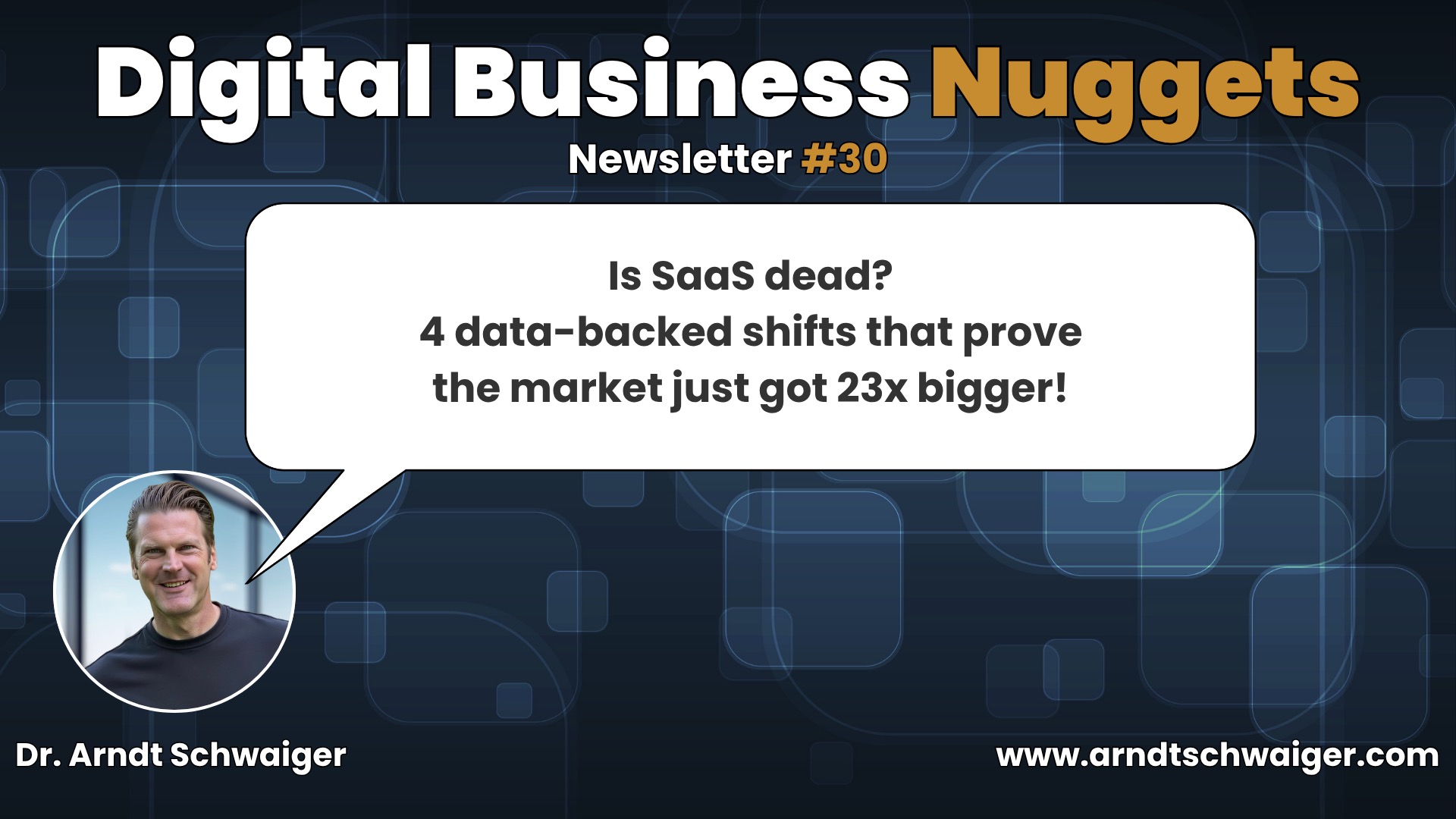
Is SaaS Dead? 4 Data-Backed Shifts That Prove the Market Just Got 23× Bigger
TL;DR: SaaS valuations just hit a 10-year low (3.4×) while AI-native companies trade at ~20×, six times the multiple. Something fundamental is shifting. I break down four shifts: users, interface, pricing, and budget with verified data from GitHub, Stripe, Zendesk, Salesforce, Goldman Sachs, and McKinsey. The bottom line: the addressable market just expanded from $200 billion to $4.6 trillion. Here's what founders should do about it.
The Data That Should Make Every Founder Pay Attention
The median public SaaS company is worth 3.4× revenue. March 2026. A ten-year low. AI-native companies? ~20×. Same stock exchange, same analysts, same quarterly scrutiny. Six times the multiple.
Something fundamental is shifting in how software is valued, built, and sold. And it is not a blip, it is structural.
I unpacked this analysis at the EU-Startups Summit in Malta for 2,500 founders and investors. The session was titled "The Death of SaaS?" with a question mark. In this edition of Digital Business Nuggets, I am sharing the full analysis with all the data behind it.
Why I Can Measure This Shift
I have been measuring SaaS business models from both the AI and the business model angle for twenty years. In 2006, I completed my PhD on multi-agent systems at DFKI, what we called "agents" in my thesis is now the core technology driving this transformation. Since then, I have coached over 600 startups through business-model shifts, every one analyzed with the Business Model DNA (BMDNA) framework I developed to make business models measurable in numbers.
When the metrics start behaving differently, I notice. And right now they are moving faster than I have seen in two decades.
Lovable: 146 people in Stockholm just crossed $400 million in ARR. One of the fastest-growing software companies in history. And not a SaaS company in any traditional sense.
Why the 6× valuation gap? I see four shifts driving it. Here is the data behind each one.
Shift 1: Users → Agents
For twenty-five years, every SaaS product assumed a human in the chair. A person logging in. Clicking buttons. Reading dashboards. Filling forms.
That assumption is breaking. The user is becoming an agent.
I see this across the startups I work with and in the market. Founders walk in with pitch decks built around human personas and GUI mockups. But when we measure actual usage patterns, something I do with every startup through the BMDNA framework, the picture looks different. Non-human traffic is growing faster than anyone in the room expected. The shift is happening before most founders realize it.
GitHub is the most visible example at scale. Before AI-based coding, the platform had 100% human developers. Today, 46% of code by developers using AI coding tools is written by AI and not by a human typing line by line. AI agents open 1.2 million pull requests per month on GitHub, the same action any human developer takes. Twenty million Copilot users. 4.7 million paying. Ninety percent of the Fortune 100 on board. (GitHub Copilot Research, 2025)
But this is not just GitHub. The shift is measurable across enterprise software:
7:1: Non-human identities (service accounts, API keys, AI agents, bots) outnumber human users 17 to 1 in enterprise SaaS. (Veza, 2026 State of Identity & Access Report, December 2025)
2.4 billion: Agentic Work Units processed on the Salesforce platform. That is 2.4 billion actions taken by AI agents inside Salesforce CRM updating records, handling cases, processing data. The agents are users of Salesforce, just like the humans. (Salesforce Q4 FY26 earnings, February 2026)
+44%: Non-human identities grew 44% in just one year, making agents the fastest-growing user type in enterprise software. (Entro Labs, NHI & Secrets Risk Report H1 2025, July 2025)
And it is not just enterprise back-office tools. Figma , the design tool, opened its canvas to AI agents. Agents are now designing inside Figma, making hundreds of API calls per session. Linear, the project management tool for developers, now lets Cursor, Devin, and Codex create and manage issues as teammates.
That is the user shift. But there is a deeper layer: the interface has to catch up.
Shift 2: Interface → API
GUIs exist because humans need to see things. Buttons. Forms. Dashboards. Agents do not need to see things. They need to call things. The entire interface layer of software is being rebuilt for a non-human user.
The enabling protocol is MCP (Model Context Protocol), created by Anthropic in November 2024 and now donated to the Linux Foundation. Think of it as a universal plug that lets any AI agent use any SaaS tool.
The adoption numbers are remarkable:
97 million monthly MCP SDK downloads as of March 2026 from near-zero in sixteen months. (Nevermined / Pento, 2026)
10,000+ live MCP servers in production: ten thousand SaaS tools that have built agent-facing API endpoints. (Digital Applied, 2026)
$1.9 trillion: Stripe 's total payment volume in 2025, up 34% year-over-year. And Stripe rebuilt its entire payment stack for agents in roughly thirteen months: Agent Toolkit (November 2024) → MCP server (February 2025) → Agentic Commerce Protocol (September 2025) → full Commerce Suite (December 2025). (Stripe 2025 Annual Letter)
At the product level, three paradigm shifts are happening simultaneously:
1. Forms become conversations. Users stop filling in fields and start describing intent.
2. The user no longer learns the app. The agent learns the user. Twenty-five years of onboarding tutorials gone.
3. UI complexity stays flat. Agent complexity grows. Your app looks simpler even as it does more.
The takeaway for founders: If your product only has a GUI, agents cannot use it. Give agents a door to your product.
Users changed. Interfaces adapted. Now the pricing models have to break.
Shift 3: Pricing → Usage
Per-seat pricing assumes a human in the chair. Twenty dollars, fifty dollars, a hundred dollars per seat per month. When agents replace forty percent of the chairs, your revenue drops forty percent, unless you change the model.
Zendesk is the clearest case of one company making the shift. Until 2024, they charged $89–$169 per support agent per month. Per seat. Whether that agent resolved one ticket or a thousand. Then in November 2024, they launched the AI Dynamic Pricing Plan: $1.50 per automated resolution. Same company. Same product. You only pay when an issue is actually resolved and the AI resolves it. Pay for outcomes, not headcount. (Zendesk AI Dynamic Pricing Plan, November 2024)
The broader data confirms this is not just Zendesk:
158% net revenue retention: Snowflake 's NRR under consumption pricing (FY2023). Existing customers expand 58% annually because they naturally consume more. Per-seat cannot replicate this. You cannot upsell someone seats they do not need. (Snowflake public earnings, FY2023)
$1 billion ARR: Cursor (by Anysphere) reached $1B in roughly eighteen months. ~300 employees. $29.3 billion valuation. All usage-priced. You are not buying access to a tool. You are buying a compute budget for the AI agent inside your editor. That is not SaaS pricing. That is a phone plan. (TechCrunch, June 2025 / CNBC, November 2025)
77% of the largest software companies now use consumption-based pricing. This is no longer an experiment. It is the industry standard. (OpenView Partners)
Three shifts down. But the biggest one, the one that explains the 6× valuation gap, is about where the money comes from.
Shift 4: Budget → HR: The 23× Reveal
This is the shift I want you to remember.
For twenty-five years, your startup competed for the software budget. $200 billion globally. Every SaaS company on Earth fighting for a slice of two hundred billion dollars.
But when your product does the work, when it replaces a person, not a tool, your customer does not pay you from the software budget anymore. They pay you from the labor and services budget.
$4.6 trillion. That is Foundation Capital 's number. The combined global spend on salaries ($2.3 trillion in sales, marketing, engineering, security, HR) and outsourced services ($2.3 trillion in IT services and business process services per Gartner).
Twenty-three times bigger. That is why all four shifts matter. Not because SaaS is dying, but because the budget pool your startup is competing for just got twenty-three times larger.
And the proof is already here:
$500/month: Goldman Sachs "hired" Devin, Cognition's AI coding agent, instead of hiring a $180,000/year software engineer. The cheque came from the engineering salary budget, not the IT tools budget. Goldman plans to deploy Devin by the thousands. (Fortune, July 2025)
$0.10 per action: Salesforce Agentforce Flex Credits. Not per seat. Not per month. Per action. The way you would pay a worker per task. Salesforce's own press release title: "Salesforce Introduces New Flexible Agentforce Pricing to Accelerate the Digital Labor Revolution." Marc Benioff on the Q4 FY26 earnings call: "Agentforce is taking millions of dollars of labour cost out of the operation of our small business customers." He says labour cost, not IT cost. (Salesforce press release, May 2025)
20,000 AI agents: McKinsey & Company now operates 20,000 AI agents alongside ~40,000 human employees. Fewer juniors, more AI. The consulting model is flattening. McKinsey CEO Bob Sternfels confirmed the numbers, with a goal of reaching one agent per person. (Fast Company / The Ken, 2025-2026)
Foundation Capital put it clearly: "When a System of Agents can complete a whole job task, it can be categorized as a personnel cost, not a software expense. This opens up a vastly bigger market opportunity."
The Answer: Service-as-a-Software
So, is SaaS dead?
No. But it has become something new.
What we called Software-as-a-Service is becoming Service-as-a-Software.
The users are becoming agents. The interfaces are becoming APIs. The pricing is becoming usage. And the budget is moving from software to labor.
Software-as-a-Service was a $200 billion market. Service-as-a-Software competes for $4.6 trillion. Same founders. Twenty-three times the opportunity.
What Founders Should Do
If you are building a startup in 2026, these four shifts should shape every strategic decision you make. Here are five actions:
1. Give agents a door to your product. If your product does not have an agent-facing API, agents cannot reach you. The door today is MCP, ninety-seven million downloads a month. If agents cannot reach your product, you are invisible to the fastest-growing user type in software.
2. Kill the seat. Add a usage tier. Test an outcome price. The founders who survive this shift will price like Cursor or Zendesk, not like Salesforce circa 2015.
3. Deliver the outcome, not the tool. Pick one workflow in your product where the software does the work, not where the user does the work with your tool. Start small. One workflow.
4. Go vertical. Domain knowledge is the moat. Code is not the moat anymore. Go narrow enough that deep domain expertise is defensible.
5. Plan for lean teams. Your next hires include many agents. Lovable built a $400 million business with 146 people. AI-native companies run 4–6× leaner than traditional SaaS.
And once you have the opportunity: validate the business model. That is why I developed BMDNA (Business Model DNA), a framework that makes any business model measurable in numbers. CAC, CLV, and the metrics investors actually ask about. I have used it with 600+ startups. The ones who validated their metrics before they scaled were the ones who survived. www.bmdna.com
The Bottom Line
SaaS is not dead. But it has become Service-as-a-Software. The market just got 23× bigger. The tools to build and execute are in your hands. The question is not whether the shift is happening. The data is clear. The question is whether you will build for the new model or keep optimizing the old one.
Same founders. Twenty-three times the opportunity.
About the Author
Dr. Arndt Schwaiger is a techpreneur, AI builder, and business angel. He holds a PhD in Artificial Intelligence (Multi-Agent Systems) from DFKI, has advised over 600 startups, and is the creator of the BMDNA framework. He is a keynote speaker on AI strategy, digital business models, and the intersection of technology, product, and business.
Website: arndtschwaiger.com